
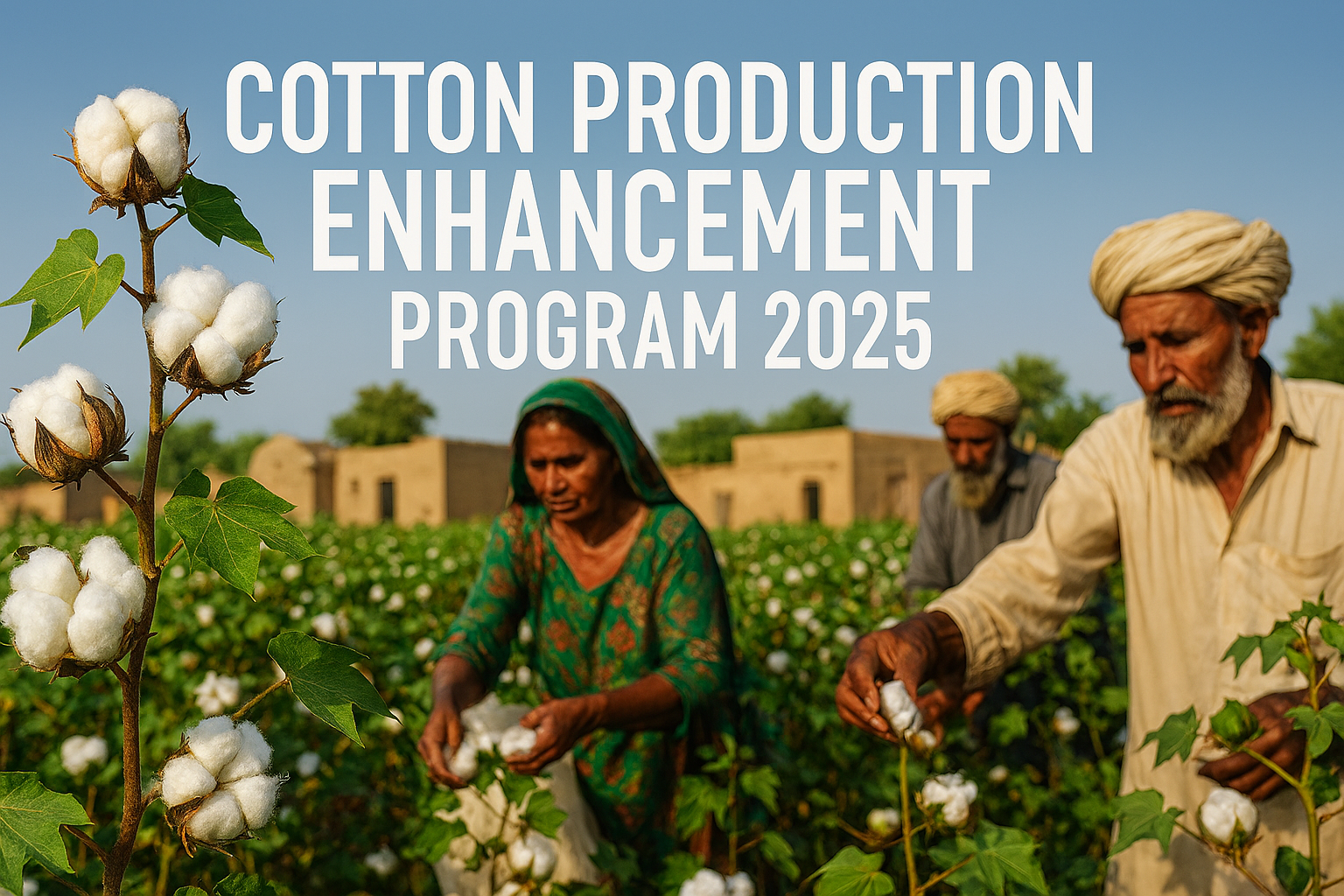
Cotton Production Enhancement Program 2025,People in Pakistan call cotton their “white gold,” and for good reason—it’s been the heart of the country’s farming and textile worlds for ages. But lately? Things haven’t been so great. Cotton production took a nosedive. Pests, unpredictable weather, bad seeds, and not enough help from the government have all piled on.Now, the government’s rolling out something big: the Cotton Production Enhancement Program 2025. The goal? Bring cotton back to life. They want better seeds, bigger harvests, more support for farmers, and a focus on keeping cotton farming sustainable for the long haul.This isn’t just about growing more cotton. It’s a real shot at turning things around for rural farmers and making Pakistan’s textile industry more competitive on the world stage. Exports go up, farmers get stronger, and cotton might just reclaim its former glory.
Also Read: Suthra Punjab Scheme 2026: Eligibility, Application & Latest Updates
Table of Contents
🎯Background and Importance of Cotton Production Enhancement Program 2025
Cotton really sits at the heart of Pakistan’s agriculture. It drives a big chunk of the country’s agricultural GDP and brings in a lot of foreign exchange. You find cotton everywhere — it keeps more than 1,200 ginning factories and 400 textile mills running, and it gives work to millions, from the farmers in the fields to the people making clothes in the factories.
If you look at the numbers from the Pakistan Bureau of Statistics, cotton adds about 0.8% to the country’s GDP and makes up almost 4% of everything agriculture produces. But things haven’t been great lately. Cotton production has slid over the past ten years — from more than 14 million bales in 2014 down to about 8 million now. Because of that drop, Pakistan has had to buy cotton from abroad, which puts more pressure on the country’s foreign reserves.
To tackle this, the Cotton Production Enhancement Program 2025 steps in. The plan? Bring in new technology, help farmers learn better ways to grow cotton, and make smarter policies to get the industry back on its feet.
Also Read: Mera Pakistan Mera Ghar (MPMG) Scheme 2026 – Complete Guide & Benefits
✨Objectives of the Cotton Production Enhancement Program 2025

The Cotton Production Enhancement Program 2025 has the following goals and objectives:
- ✅Increase Cotton Yield per Acre: Create opportunities to increase yield/acre with biotechnology seed varieties, irrigation and pest management systems.
- ✅Reduce Production Costs: Aid in smallholder producers reduce production costs with subsidies to fertilizers (organic cotton producers), pesticides, and certified seed.
- ✅Improve Sustainable Farming Practices: Implement sustainability with organic pesticides, water efficient drip irrigation and understanding soil health.
- ✅Increase Farmers Capacity/Training: Continue to have training events, workshops, demonstrations to farmers to assist in modern farming to understand principles of modern farming.
- ✅Increase Value in Cotton Chain: Provide farmers a connectedness to ginners/spinners/exporters in the pricing structure and profits.
- ✅Promote Research and Development (R&D): Partner with sustainable agricultural research institutions/universities on developing climate and pest-resistance cotton.
Also Read: Cotton Production Enhancement Program 2025 https://mnfsr.gov.pk/Detail/OTAxYWExNDgtZGEwMy00ZGI3LThlMmQtNWZkNGRjZWZmNzIy📌Key Components of Cotton Production Enhancement Program 2025
The Cotton Production Enhancement Program 2025 will evolve as a multi-faceted program. The major components of the program will include:
- ✅Making Available High-Quality Seed of Improved Lewis Class Cotton
Access to high-quality seed is fundamental to improving cotton yield. The program will provide farmers with a subsidy that can be used towards purchasing certified seed improved by the Central Cotton Research Institute (CCRI) and Pakistan Central Cotton Committee (PCCC). The types of seed available will have some genetic resistance to bollworm and whitefly attack and will be resilient to a variety of climate conditions.
- ✅Management of Pest and Diseases
The incidence of pests is the second highest contributor to low cotton yield and the Cotton Production Enhancement Program 2025 supports some degree of a multi-faceted approach, with somewhat specific reference to Integrated Pest Management (IPM) techniques. Training will be provided for the monitoring of fields, identifying early signs of pest incidence, using agricultural agents for biological control and just-in-time use of pesticides. As part of its institutional program, pest monitoring relief teams will come to cotton fields with enough regularity to improve farmers or with develop farmers assistance.
- ✅Modern Irrigation and Water Management
Many areas that grow cotton are currently experiencing low productivity because of mismanagement of water and drought, and new measures should be developed for facilitating more efficient water delivery to cotton growers, priority should be given to developing drip irrigation and sprinkler systems.
Also Read: CM Punjab Government Jobs 2026 – Complete Guide & Latest Vacancies
- ✅Education and Capacity Building for Producers
Education is an important aspect of this initiative. The government would coordinate closely with agricultural universities and agricultural extension departments to create education for producers that would include workshops and field schools, on the best practices in the areas of cultivation, seeding, pest control and harvesting. The education will also focus on promoting the use of digital and app-based systems to disseminate data about the weather and general information.
- ✅Financial Support/Subsidies
To help divert some costs to the farmer, the Cotton Production Enhancement Program 2025 would provide varying degrees of financial support such as:
Low interest loans from the Farming Development Bank (Zarai Taraqiati Bank Limited (ZTBL)).
Subsidized agricultural inputs, such as seeds, fertilizer, irrigation tools and equipment.
Crop insurance to cover loss from drought.
Also Read: 11th Class Result 2025 – Check Online & Gazette Downloads (All Boards)
- ✅Applied Research and Development
The program would also include applied R&D to develop new cotton varieties, with yields significantly greater than the existing varieties, be drought resistant, and be resistant to the major cotton pests. Presents research centers in Multan, Faisalabad and Bahawalpur are currently being designed to feature biotechnology and support genetic research. R&D in the production of cotton since it began and working with international partners to facilitate learning and build R&D in the field of cotton in Pakistan.
💥Expected Outcomes of Cotton Production Enhancement Program 2025

The following illustrates possible advantages of the Cotton Productivity Improvement Programme 2025; however, it is not confined to just these advantages:
Also Read: Ramadan Relief Package 2026 – Complete Guide & Eligibility
- Increased Cotton Production:
The Government is trying to increase the amount of Cotton produced from 8 million to 15 million bales within a three-year span.
- Increased Farmer’s Income:
It is anticipated that lower production costs and increased cotton yields will improve Farmer’s incomes by maybe 30-40%.
- Decreased Imports:
As we increase domestic production of Cotton, we will progressively decrease the need to purchase Cotton from other countries and we will develop savings in foreign exchange.
- Employment Creation:
The agricultural sector and ginning and textiles will generate thousands of direct and indirect jobs.
- Sustainable Agronomic Practices:
Soil health and water sustainability will improve in the long-term as the uptake and / or the adoption of sustainable agronomic practices increases.
Also Read: Balochistan Rural Support Programme (BRSP): Empowering Rural Communities
🏛️Government and Institutional Support
The Ministry of National Food Security & Research (MNFSR), in collaboration with provincial agriculture agencies, Pakistan Central Cotton Committee (PCCC) and National Agricultural Research Council (NARC), is implementing this program, with technical and financial support from associated agencies FAO (Food and Agriculture Organization) and USAID .Provincial governments are active in regional project implementation that relates with this national program in those provinces, which border together for about 90% of cotton production of Pakistan, especially Punjab and Sindh.
🌾The Role of Technology in Cotton Enhancement
The agriculture sector in Pakistan has now entered a phase of digitization. The implications are as follows:
- ✅Drones are being used to check for pests, and check for crop health.
- ✅Mobile apps are available that give weather information, fertilizer recommendations, and market prices real time.
- ✅Satellite imagery can be used to assess crops and highlight which areas (within fields) are under stress and need crop focusing.
These innovations represent significant steps toward smarter, productive, and climate resilient cotton production.
Also Read: CM Punjab Internship Program 2026 – Agriculture Sector Opportunities
👉Conclusion
The Cotton Production Enhancement Program 2025 is a milestone in Pakistan’s agricultural development. This program is looking to make cotton farming a sustainable and economically-viable sector while using advanced technology and farmer support as the focal area. If successful, it will restore Pakistan’s prominence as a premier cotton producing country, raise rural livelihoods, and contribute to economic growth.
This initiative is not just an agricultural initiative; it embodies revival, resilience and reform, in the agricultural sector in Pakistan.
What are the main goals of the program?
The primary goals are to:
Increase cotton yield per acre.
Reduce input costs for farmers.
Improve seed quality and pest resistance.
Promote sustainable and eco-friendly farming.
Strengthen the cotton value chain and export potential.
How will farmers benefit from this program?
Farmers will receive subsidized seeds, fertilizers, and pesticides, as well as training sessions on modern farming techniques. They can also access low-interest loans and crop insurance under this program, which will help them improve productivity and reduce financial risks.
What technologies are being used in this initiative?
Modern technologies such as drone surveillance, satellite mapping, mobile-based advisory apps, and drip irrigation systems are being introduced. These innovations will help farmers monitor crops, manage water efficiently, and protect fields from pests and diseases.
How does the program address climate change and pest issues?
The program encourages climate-resilient seed varieties and integrated pest management (IPM). It promotes environmentally safe pesticides, crop rotation, and soil health management to combat the negative effects of climate change and pest infestations.
How can farmers apply or participate in the program?
Farmers can register through their district agriculture offices or visit the official website of the Ministry of National Food Security & Research (MNFSR). In some provinces, mobile apps and local agriculture helplines are also available for easy registration and information.